NHS Is Testing New Cancer Vaccine? What?
5 views
Share:
You might have seen the headlines recently and paused.
The words cancer and vaccine do not usually sit together in the same sentence.
We are used to vaccines preventing things like measles or flu.
We are used to cancer being treated with surgery or chemotherapy or radiotherapy.
But the idea of a vaccine that treats cancer sounds like science fiction.
It sounds like something from a future we have not quite reached yet.
Except it is happening right now in the NHS.
It is not a distant dream or a theoretical paper sitting on a dusty shelf.
Real patients are rolling up their sleeves and receiving these treatments today.
The NHS has launched something called the Cancer Vaccine Launch Pad.
It is a name that sounds almost like a space mission.
In many ways it is exactly that kind of moonshot.
The goal is to fast track thousands of patients into clinical trials for these new treatments.
This initiative is connecting patients with personalised mRNA vaccines.
If that acronym sounds familiar it is because you have heard it a lot in the last few years.
The same technology that gave us the Covid vaccines is now being turned against tumours.
It is a fascinating pivot in medical history.
We are witnessing a moment where we stop just cutting out the disease and start teaching the body to fight it.
The scale of this project is significant.
The NHS aims to reach ten thousand patients by the year 2030.
That is a lot of people who might otherwise have run out of options.
It is a project that combines the sheer size of the NHS with the agility of modern biotech.
The concept is simple but the science is incredibly complex.
These vaccines are not off the shelf products you pick up at a pharmacy.
They are often custom built for the individual patient.
They are designed to recognise the specific mutations in your specific cancer.
This is precision medicine in its purest form.
It is the difference between a suit off the rack and one tailored to your exact measurements.
Let us explore what this actually looks like for the people involved.
The Launch Pad is essentially a matchmaking service.
It connects patients in hospitals across England with the trials that need them.
Before this a patient might have missed out simply because their local hospital was not running the right study.
Now the system is designed to cast a wider net.
It is an attempt to democratise hope.
But you are probably wondering which cancers are actually being targeted.
You want to know if this applies to you or your loved ones.
The trials are rolling out in stages and covering specific types of disease.
Let us break down exactly what is being tested and where the focus lies.
Colorectal Cancer
The first port of call for this new initiative was bowel cancer.
This is one of the most common cancers in the UK and often one of the most difficult to manage if it spreads.
The very first patient to receive a personalised vaccine through the Launch Pad had this diagnosis.
His name is Elliot Phebve and he is a lecturer and father of four.
His story was widely reported and it gave a human face to the abstract science.
He had surgery to remove his tumour but surgery cannot always catch every single cell.
Microscopic traces of cancer can hide in the bloodstream.
These lingering cells are often what cause the disease to return months or years later.
The vaccine he received was designed to hunt down these remnants.
It was created by analysing the genetic makeup of his specific tumour.
Scientists looked for mutations that belonged only to the cancer and not to his healthy cells.
They then encoded instructions into the vaccine to flag these mutations to his immune system.
It is like giving a sniffer dog a scent to track.
The immune system is powerful but cancer is a master of disguise.
Tumours often cloak themselves or put the immune system to sleep.
The vaccine rips away that disguise.
It tells the body exactly what the enemy looks like.
For colorectal cancer patients this could be a game changer.
Recurrence is a huge fear for anyone who has been through treatment.
The anxiety of the follow up scan is a heavy burden to carry.
If a vaccine can reduce that risk it changes the entire psychological landscape of the disease.
The trial Elliot joined is looking at whether this approach can prevent the cancer coming back.
It is currently being tested on patients who have already had their primary treatment.
The hope is that it cleans up the mess left behind.
We are still waiting for long term data but the early signs are what researchers call promising.
That word promising does a lot of heavy lifting in science.
It means we are optimistic but we need to be patient.
Skin Cancer
Melanoma has long been the poster child for immunotherapy.
Skin cancer tends to have a high number of mutations which makes it easier for the immune system to spot.
It was one of the first cancers to respond well to earlier checkpoint inhibitor drugs.
Now it is a prime target for these new vaccines.
The Launch Pad is expanding to include trials for melanoma patients.
The approach here is slightly different depending on the specific trial.
Some vaccines are personalised like the bowel cancer one.
Others are what we call off the shelf vaccines.
These target common markers that appear in many melanoma cases.
They do not need to be built from scratch for every single person.
This makes them faster to produce and easier to distribute.
The University of Southampton has been a key player in coordinating these trials.
They are working with companies like BioNTech and Scancell.
For a patient with advanced melanoma the options can be limited.
Once the cancer spreads to other organs it becomes much harder to control.
A vaccine offers a new line of defence.
It aims to boost the response to other drugs the patient is already taking.
Imagine the vaccine as a turbocharger for the immune system.
It revs up the T cells so they are more aggressive and more focused.
Trials are looking at using these vaccines alongside standard immunotherapy.
The theory is that the combination will be more effective than either treatment alone.
It is a strategy of hitting the cancer from two angles at once.
One drug releases the brakes on the immune system.
The vaccine presses the accelerator.
We have seen incredible progress in melanoma survival rates in the last decade.
This could be the next leap forward.
Head and Neck Cancer
This is the latest addition to the portfolio of trials.
Head and neck cancers can be particularly brutal because of where they grow.
They affect speech and swallowing and breathing.
Treatment often involves difficult surgery or intense radiotherapy.
Many of these cancers are caused by the HPV virus.
You might know HPV from the cervical cancer vaccination programme for teenagers.
But the virus also drives cancers in the throat and mouth.
The new vaccine trial targets these HPV related cancers.
It is designed to train the immune system to attack cells that carry the viral proteins.
Because the virus is foreign to the body it makes a good target.
The immune system is naturally wired to fight viruses.
The vaccine reminds the body that these cancer cells are infected and dangerous.
NHS England recently announced that patients are being fast tracked into this trial.
It involves hospitals across the country from Southampton to Liverpool.
For patients with recurrent head and neck cancer the outlook has historically been poor.
Standard treatments often stop working after a while.
A vaccine offers a chance to retrain the immune defence when it has run out of steam.
It is offering hope to a group of patients who desperately need new options.
The trial is known as AHEAD MERIT.
It is a clever name but the intent is serious.
They are looking for patients where the cancer has returned or spread.
If successful this could become a standard part of care for HPV positive cancers.
It shows how versatile this technology really is.
It can be adapted for genetic mutations or for viral triggers.
The underlying mRNA platform is like a cassette player.
You just change the tape to play a different song.
Lung and Pancreatic Cancer

These are the difficult ones.
Lung cancer and pancreatic cancer are notoriously hard to treat.
They are often diagnosed late and they can be very aggressive.
But the Launch Pad has them in its sights.
There are plans to open trials for these indications as the programme expands.
Lung cancer is the leading cause of cancer death in the UK.
There is a separate initiative called LungVax being developed at Oxford.
That project is looking at preventing lung cancer in high risk people.
But the BioNTech partnership is also interested in treating established lung cancer.
The challenge with lung cancer is that it hides well.
But it also has vulnerabilities that a vaccine could exploit.
Pancreatic cancer is perhaps the toughest challenge of all.
It has a thick protective shell that drugs struggle to penetrate.
However early research suggests vaccines might be able to break through.
A small study in New York made headlines recently for showing long term survival in some pancreatic patients.
The NHS wants to replicate that kind of success on a larger scale.
They are preparing the ground for trials that will include these patients.
It is not just about the easy wins.
They are going after the cancers that have baffled oncologists for decades.
It is a bold strategy.
It acknowledges that we need something radical for these diseases.
Current chemotherapy is often not enough.
We need the precision of the immune system to make a real dent in the mortality figures.
The Science Behind the Hope
It is worth pausing to understand why this is happening now.
The concept of a cancer vaccine is not actually new.
Scientists have been trying to make this work for over a hundred years.
There were attempts in the nineteenth century that had mixed results.
But they lacked the tools to understand the genetics.
They were shooting in the dark.
Today we have the full map of the human genome.
We can sequence a tumour in a matter of days.
We have the computing power to analyse that data and find the targets.
And we have the delivery mechanism in mRNA.
This is the golden triangle of technologies coming together.
Genomics plus AI plus mRNA.
That is why there is so much confidence this time around.
Professor Peter Johnson is the National Clinical Director for Cancer at NHS England.
He has been very vocal about the potential of this programme.
He said that we know that even after a successful operation cancers can sometimes return because a few cancer cells are left in the body but using a vaccine to target those remaining cells may be a way to stop this happening.
It is a cautious but powerful statement.
He is not promising a cure for everyone.
He is suggesting a new way to manage the risk.
Amanda Pritchard the Chief Executive of the NHS has also championed this.
She called the treatment of the first patient a landmark moment.
She sees the NHS as a unique test bed for this technology.
Because we have a national system we can organise trials faster than fragmented systems.
We can identify patients across the whole country.
This is a huge advantage for researchers who need to find specific people for specific trials.
It is one of the few times where the sheer size of the NHS is a benefit rather than a hurdle.
A Shift in Perspective
We often talk about the war on cancer.
We use violent language like battling and fighting and destroying.
But a vaccine is a more subtle kind of weapon.
It is about intelligence rather than brute force.
Chemotherapy is like a carpet bombing campaign.
It kills cancer cells but it also damages healthy cells.
That is why you lose your hair and feel so sick.
It is toxic to the whole system.
A vaccine is like a sniper.
It teaches the body to take out only the bad actors.
This should theoretically mean fewer side effects.
Patients on these trials often report flu like symptoms for a day or two.
But they do not generally lose their hair or have their immune system wiped out.
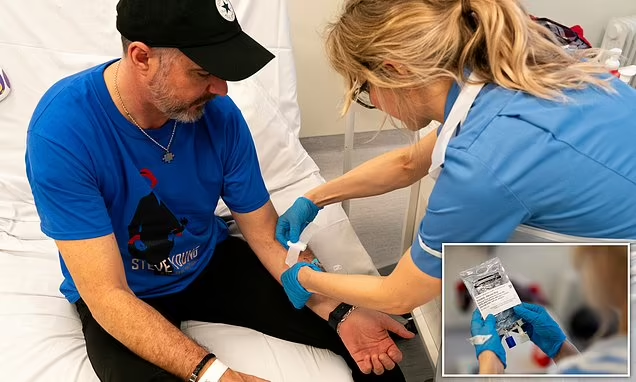
They can often carry on with their daily lives.
This quality of life aspect is huge.
Surviving cancer is one thing.
Living well during treatment is another.
If we can turn cancer treatment into a series of injections rather than months of toxicity that is a revolution.
It changes the experience of being a patient.
It turns a terrifying ordeal into something more manageable.
Of course we must be realistic.
Not every vaccine will work for every patient.
Cancer is incredibly adaptable.
It can evolve to hide from the immune system again.
We might need booster shots or new versions of the vaccine over time.
It might become a chronic condition that we manage rather than cure outright.
But even that would be a massive victory.
Turning a terminal illness into a manageable chronic disease is a valid goal.
We have done it with HIV.
We could potentially do it with advanced cancer.
The Road Ahead
The year 2030 is the target for those ten thousand patients.
It seems like a long way off but in medical research terms it is tomorrow.
The pace of recruitment is picking up.
More hospitals are joining the Launch Pad every month.
More pharmaceutical companies are looking to bring their trials to the UK.
The success of the Covid vaccine rollout proved that the UK can do this.
We have the infrastructure and the public trust.
People here are generally willing to participate in research.
That altruism is the engine of the whole project.
Every patient who signs up is helping not just themselves but the people who come after them.
They are pioneers in the truest sense.
They are stepping into the unknown.
There is a lovely quote from Marie Curie that feels relevant here.
She said that nothing in life is to be feared it is only to be understood.
She also said that now is the time to understand more so that we may fear less.
That is exactly what these trials are doing.
They are using our understanding of biology to reduce the fear of cancer.
We are stripping away the mystery of the disease.
We are reducing it to a code that we can hack.
For anyone reading this who is currently navigating a diagnosis this news offers a glimmer of light.
It might not be the standard of care just yet.
You cannot walk into your GP surgery and ask for a cancer vaccine today.
But the door is opening.
If you are being treated at a major centre it is worth asking your oncologist about the Launch Pad.
Ask if there are trials you might be eligible for.
The landscape is changing so fast that what was impossible yesterday might be possible today.
You can find more detailed information on the NHS England website.
There are also resources available through Cancer Research UK which tracks these developments closely.
The University of Southampton also maintains updates on their specific role in the trials.
These institutions are the best places to look for verified information.
Avoid the hype and look for the data.
A Final Thought
We are living through a quiet revolution.
It is not being fought with loud explosions but with microscopic molecules.
The messenger RNA technology is a messenger in more ways than one.
It brings a message of instruction to our cells.
But it also brings a message of hope to us.
It tells us that we are not helpless against this disease.
It tells us that human ingenuity is catching up with biological chaos.
The NHS Cancer Vaccine Launch Pad is just the beginning.
It is the testing ground for a new era of medicine.
An era where we use the body's own wisdom to heal itself.
It is a time to be cautiously excited.
It is a time to watch the science unfold.
And it is a time to believe that the sentence containing the words cancer and vaccine will soon be the most normal thing in the world.
Related Posts

Exploring the Impact of Native NVMe Support in Windows Server 2025
The introduction of native NVMe support in Windows Server 2025 heralds a new era of speed and efficiency in data handling, drastically improving the performance landscape for servers. This article delves into the precise enhancements and their implications for businesses.

How to make money in 2026
